Dec 2, 2025
From Social Media to Interest Media: Why Traditional Influencer Marketing Is Broken
From Social Media to Interest Media: Why Traditional Influencer Marketing Is Broken
From Social Media to Interest Media: Why Traditional Influencer Marketing Is Broken
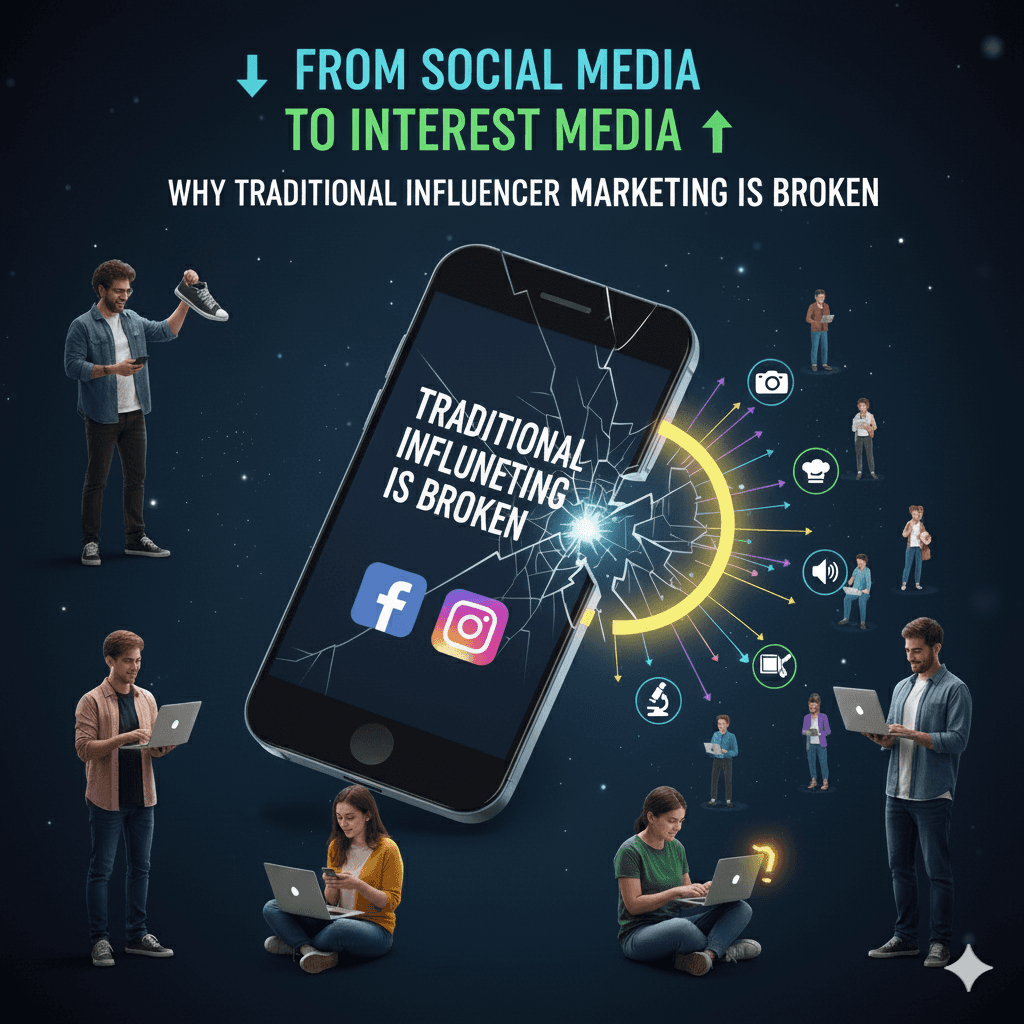
Ten years ago, social media meant checking what your cousin posted from their holiday or liking a picture of your friend’s new dog.
Today, open Instagram or TikTok and your feed is something else entirely. You see people you do not know, ultra specific trends, niche obsessions, and content that feels weirdly tailored to your current rabbit hole.
Social has quietly turned into interest media.
We do not really open these apps to keep up with people we know. We open them to be entertained.
The mismatch: entertainment feed, advertising strategy
This is where traditional influencer marketing runs into a wall.
Most brands still behave as if social is a place where people are ready to discover products, compare options, and move into a purchase funnel. In reality, users are there to scroll, laugh, get inspired, and escape for a few minutes.
So brands pay a handful of big influencers to parachute ads into feeds that were designed for entertainment. On paper it looks good. Large follower counts, high reach, fancy media kits.
In practice, it often becomes expensive wallpaper. People swipe past, or they watch without any intention of buying.
The 1 percent problem
Almost all of the money in influencer marketing flows to a tiny group of creators. They are talented, but they are also far removed from how normal people buy and share.
The pattern is familiar:
A celebrity or macro creator who has never used the product suddenly "cannot live without it". They post once or twice, the brand pays a big invoice, and everyone hopes to see sales.
The harsh reality is that most of the time, this does not move the needle. The campaign might generate views and likes, yet it leaves the brand with very little clarity on net new customers or true return on investment.
Why the data still feels like guesswork
At the same time, performance dashboards create an illusion of precision. CPM, CTR, reach, views, promo code usage.
Behind the scenes, the big platforms protect the data that really matters. They know exactly how user journeys work, but they rarely give brands full visibility. This is not an accident. Advertising is their engine, and opacity keeps budgets flowing.
So marketers are stuck in the middle. They feel pressure to use influencer marketing because "everyone does it", but they rarely have a clean line from creator content to actual sales and margin.
The real shift: content finds its own audience
The irony is that social media has never been more powerful for brands. The problem is not the medium, it is the model.
Today, content creates its own reach. Algorithms favour posts that are relevant, engaging and native to the platform. Great creative travels because it genuinely resonates, not because it has a big media budget behind it.
Relevance creates attention. Attention creates consideration. Consideration can lead to sales.
The winners are not necessarily the biggest influencers. They are the people who create content that feels real, specific, and aligned with what a given audience cares about in that moment.
So what needs to change?
To fix influencer marketing, we have to fix the incentives.
Stop assuming that paying a few big names will always produce sales
Stop worshipping vanity metrics as if they were proof of business impact
Start aligning spend with real customer behaviour on interest based platforms
People already talk about what they buy, where they go, what they wear. They are already creating content that influences their friends and followers.
The next generation of influencer marketing will be built on that reality. Not on forcing more ads into feeds, but on rewarding the everyday influence that already drives decisions.
This is exactly the space Linkfluencer is focused on. Instead of betting everything on the top 1 percent, we are building tools that let brands tap into the millions of customers and micro creators who actually shape culture and demand.
Ten years ago, social media meant checking what your cousin posted from their holiday or liking a picture of your friend’s new dog.
Today, open Instagram or TikTok and your feed is something else entirely. You see people you do not know, ultra specific trends, niche obsessions, and content that feels weirdly tailored to your current rabbit hole.
Social has quietly turned into interest media.
We do not really open these apps to keep up with people we know. We open them to be entertained.
The mismatch: entertainment feed, advertising strategy
This is where traditional influencer marketing runs into a wall.
Most brands still behave as if social is a place where people are ready to discover products, compare options, and move into a purchase funnel. In reality, users are there to scroll, laugh, get inspired, and escape for a few minutes.
So brands pay a handful of big influencers to parachute ads into feeds that were designed for entertainment. On paper it looks good. Large follower counts, high reach, fancy media kits.
In practice, it often becomes expensive wallpaper. People swipe past, or they watch without any intention of buying.
The 1 percent problem
Almost all of the money in influencer marketing flows to a tiny group of creators. They are talented, but they are also far removed from how normal people buy and share.
The pattern is familiar:
A celebrity or macro creator who has never used the product suddenly "cannot live without it". They post once or twice, the brand pays a big invoice, and everyone hopes to see sales.
The harsh reality is that most of the time, this does not move the needle. The campaign might generate views and likes, yet it leaves the brand with very little clarity on net new customers or true return on investment.
Why the data still feels like guesswork
At the same time, performance dashboards create an illusion of precision. CPM, CTR, reach, views, promo code usage.
Behind the scenes, the big platforms protect the data that really matters. They know exactly how user journeys work, but they rarely give brands full visibility. This is not an accident. Advertising is their engine, and opacity keeps budgets flowing.
So marketers are stuck in the middle. They feel pressure to use influencer marketing because "everyone does it", but they rarely have a clean line from creator content to actual sales and margin.
The real shift: content finds its own audience
The irony is that social media has never been more powerful for brands. The problem is not the medium, it is the model.
Today, content creates its own reach. Algorithms favour posts that are relevant, engaging and native to the platform. Great creative travels because it genuinely resonates, not because it has a big media budget behind it.
Relevance creates attention. Attention creates consideration. Consideration can lead to sales.
The winners are not necessarily the biggest influencers. They are the people who create content that feels real, specific, and aligned with what a given audience cares about in that moment.
So what needs to change?
To fix influencer marketing, we have to fix the incentives.
Stop assuming that paying a few big names will always produce sales
Stop worshipping vanity metrics as if they were proof of business impact
Start aligning spend with real customer behaviour on interest based platforms
People already talk about what they buy, where they go, what they wear. They are already creating content that influences their friends and followers.
The next generation of influencer marketing will be built on that reality. Not on forcing more ads into feeds, but on rewarding the everyday influence that already drives decisions.
This is exactly the space Linkfluencer is focused on. Instead of betting everything on the top 1 percent, we are building tools that let brands tap into the millions of customers and micro creators who actually shape culture and demand.
Ten years ago, social media meant checking what your cousin posted from their holiday or liking a picture of your friend’s new dog.
Today, open Instagram or TikTok and your feed is something else entirely. You see people you do not know, ultra specific trends, niche obsessions, and content that feels weirdly tailored to your current rabbit hole.
Social has quietly turned into interest media.
We do not really open these apps to keep up with people we know. We open them to be entertained.
The mismatch: entertainment feed, advertising strategy
This is where traditional influencer marketing runs into a wall.
Most brands still behave as if social is a place where people are ready to discover products, compare options, and move into a purchase funnel. In reality, users are there to scroll, laugh, get inspired, and escape for a few minutes.
So brands pay a handful of big influencers to parachute ads into feeds that were designed for entertainment. On paper it looks good. Large follower counts, high reach, fancy media kits.
In practice, it often becomes expensive wallpaper. People swipe past, or they watch without any intention of buying.
The 1 percent problem
Almost all of the money in influencer marketing flows to a tiny group of creators. They are talented, but they are also far removed from how normal people buy and share.
The pattern is familiar:
A celebrity or macro creator who has never used the product suddenly "cannot live without it". They post once or twice, the brand pays a big invoice, and everyone hopes to see sales.
The harsh reality is that most of the time, this does not move the needle. The campaign might generate views and likes, yet it leaves the brand with very little clarity on net new customers or true return on investment.
Why the data still feels like guesswork
At the same time, performance dashboards create an illusion of precision. CPM, CTR, reach, views, promo code usage.
Behind the scenes, the big platforms protect the data that really matters. They know exactly how user journeys work, but they rarely give brands full visibility. This is not an accident. Advertising is their engine, and opacity keeps budgets flowing.
So marketers are stuck in the middle. They feel pressure to use influencer marketing because "everyone does it", but they rarely have a clean line from creator content to actual sales and margin.
The real shift: content finds its own audience
The irony is that social media has never been more powerful for brands. The problem is not the medium, it is the model.
Today, content creates its own reach. Algorithms favour posts that are relevant, engaging and native to the platform. Great creative travels because it genuinely resonates, not because it has a big media budget behind it.
Relevance creates attention. Attention creates consideration. Consideration can lead to sales.
The winners are not necessarily the biggest influencers. They are the people who create content that feels real, specific, and aligned with what a given audience cares about in that moment.
So what needs to change?
To fix influencer marketing, we have to fix the incentives.
Stop assuming that paying a few big names will always produce sales
Stop worshipping vanity metrics as if they were proof of business impact
Start aligning spend with real customer behaviour on interest based platforms
People already talk about what they buy, where they go, what they wear. They are already creating content that influences their friends and followers.
The next generation of influencer marketing will be built on that reality. Not on forcing more ads into feeds, but on rewarding the everyday influence that already drives decisions.
This is exactly the space Linkfluencer is focused on. Instead of betting everything on the top 1 percent, we are building tools that let brands tap into the millions of customers and micro creators who actually shape culture and demand.
Subscribe to our newsletter for upcoming updates & news.
Support
Contact Us
Subscribe to our newsletter for upcoming features
Support
Contact Us
Subscribe to our newsletter for upcoming features
Support
Contact Us

En
En