Dec 2, 2025
From Clicks and Coupon Codes to Purchases and Posts: A New Performance Model for Influencer Marketing
From Clicks and Coupon Codes to Purchases and Posts: A New Performance Model for Influencer Marketing
From Clicks and Coupon Codes to Purchases and Posts: A New Performance Model for Influencer Marketing
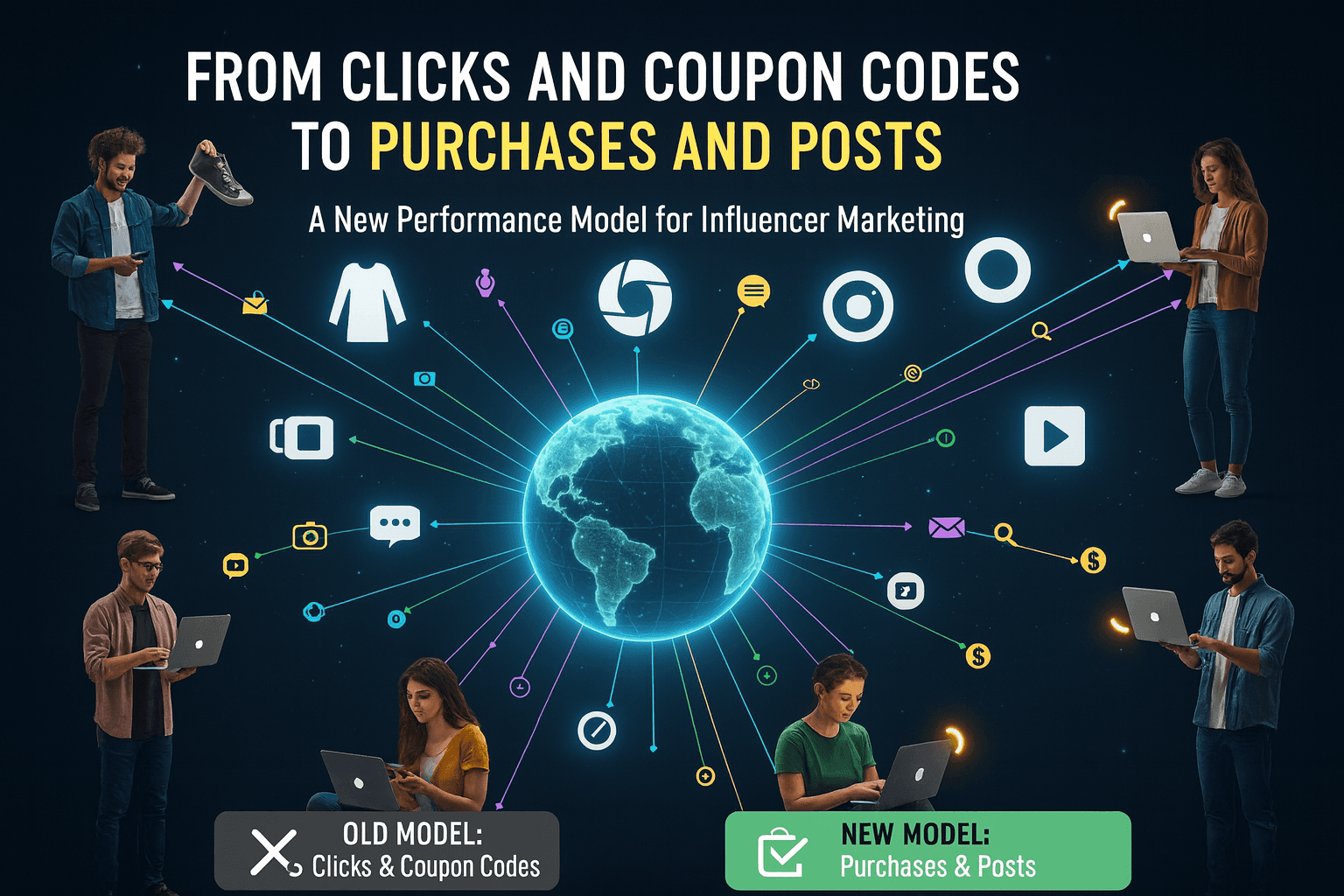
If you look at most influencer dashboards today, you will see the same set of numbers repeated. Clicks. Impressions. Reach. Promo code usage. Swipe ups.
These metrics are not useless, but they often distract from the only questions that really matter:
How many net new customers did we win?
What revenue did this activity create?
How sustainable is it if we scale the spend?
Most influencer and affiliate setups are still built around the wrong unit of value. They reward exposure more than they reward outcomes.
The problem with codes and links
Discount codes and affiliate links were meant to fix this. In theory they connect a sale back to a creator. In reality, they are messy.
Codes get shared in private chats or on coupon sites
Links break, expire, or open in the browser instead of native apps
Attribution battles create friction between channels
Creators often feel underpaid because a lot of influence is invisible to the tracking mechanism. Brands feel unsure because code based reporting rarely captures the full picture.
Everyone is doing "performance", but it does not feel very performance driven.
A different unit: purchase plus post
Linkfluencer flips the unit of value from "click" to "purchase + post".
Instead of paying for potential, brands pay for a clearly defined action that has both:
A confirmed purchase
A public piece of content
If a user buys your product and publishes a post that meets your guidelines, that is a strong signal of real intent and influence. It is worth rewarding.
If they only click a link but never buy, or only buy but never talk about it, there is nothing to pay out.
How the Linkfluencer flow works
The engine behind this model looks like this:
User connects social account and shops
They browse partner brands and shop as they normally would.User creates a post
They share content that shows the product in use and tag the brand.User uploads receipt and post in the app
Linkfluencer verifies the purchase, checks basic fraud signals, and evaluates content against the brand’s rules.If approved, payout is triggered
The user receives a fixed or variable reward in their Linkfluencer balance, which they can withdraw.
The brand’s budget only moves when both a sale and a qualifying post exist together. The fundamental metric becomes "cost per purchase plus post".
Why this matters for brands
This performance model has several advantages:
Spend is tied to actual revenue producing events
You get UGC and reach as part of the same transaction
You can measure how much it costs to generate each purchase plus post, and adjust budgets according to real results
You build a library of content you can later repurpose or amplify
For finance and leadership teams, it becomes easier to see influencer efforts in the same frame as other acquisition channels, instead of treating them as a fuzzy branding activity.
Why this matters for creators and customers
On the other side, the model is easy to understand.
Users know that if they buy, post, and meet the criteria, they get paid. There is no guessing, no opaque algorithm about how much they will receive, no long delays.
It feels like a cashback on influence, not a gamble on future commissions.
A cleaner way to do performance influencer marketing
Performance marketing will always be part of the picture. The question is what behaviour you choose to reward.
By shifting focus from clicks and codes to purchases and posts, Linkfluencer tries to align everyone around outcomes that matter:
Customers get rewarded for the real influence they already have
Brands pay for real sales with content attached
Creators gain a predictable way to monetise their social presence
It is a small change in definition, but once you adopt it, the way you think about influencer marketing starts to look very different.
If you look at most influencer dashboards today, you will see the same set of numbers repeated. Clicks. Impressions. Reach. Promo code usage. Swipe ups.
These metrics are not useless, but they often distract from the only questions that really matter:
How many net new customers did we win?
What revenue did this activity create?
How sustainable is it if we scale the spend?
Most influencer and affiliate setups are still built around the wrong unit of value. They reward exposure more than they reward outcomes.
The problem with codes and links
Discount codes and affiliate links were meant to fix this. In theory they connect a sale back to a creator. In reality, they are messy.
Codes get shared in private chats or on coupon sites
Links break, expire, or open in the browser instead of native apps
Attribution battles create friction between channels
Creators often feel underpaid because a lot of influence is invisible to the tracking mechanism. Brands feel unsure because code based reporting rarely captures the full picture.
Everyone is doing "performance", but it does not feel very performance driven.
A different unit: purchase plus post
Linkfluencer flips the unit of value from "click" to "purchase + post".
Instead of paying for potential, brands pay for a clearly defined action that has both:
A confirmed purchase
A public piece of content
If a user buys your product and publishes a post that meets your guidelines, that is a strong signal of real intent and influence. It is worth rewarding.
If they only click a link but never buy, or only buy but never talk about it, there is nothing to pay out.
How the Linkfluencer flow works
The engine behind this model looks like this:
User connects social account and shops
They browse partner brands and shop as they normally would.User creates a post
They share content that shows the product in use and tag the brand.User uploads receipt and post in the app
Linkfluencer verifies the purchase, checks basic fraud signals, and evaluates content against the brand’s rules.If approved, payout is triggered
The user receives a fixed or variable reward in their Linkfluencer balance, which they can withdraw.
The brand’s budget only moves when both a sale and a qualifying post exist together. The fundamental metric becomes "cost per purchase plus post".
Why this matters for brands
This performance model has several advantages:
Spend is tied to actual revenue producing events
You get UGC and reach as part of the same transaction
You can measure how much it costs to generate each purchase plus post, and adjust budgets according to real results
You build a library of content you can later repurpose or amplify
For finance and leadership teams, it becomes easier to see influencer efforts in the same frame as other acquisition channels, instead of treating them as a fuzzy branding activity.
Why this matters for creators and customers
On the other side, the model is easy to understand.
Users know that if they buy, post, and meet the criteria, they get paid. There is no guessing, no opaque algorithm about how much they will receive, no long delays.
It feels like a cashback on influence, not a gamble on future commissions.
A cleaner way to do performance influencer marketing
Performance marketing will always be part of the picture. The question is what behaviour you choose to reward.
By shifting focus from clicks and codes to purchases and posts, Linkfluencer tries to align everyone around outcomes that matter:
Customers get rewarded for the real influence they already have
Brands pay for real sales with content attached
Creators gain a predictable way to monetise their social presence
It is a small change in definition, but once you adopt it, the way you think about influencer marketing starts to look very different.
If you look at most influencer dashboards today, you will see the same set of numbers repeated. Clicks. Impressions. Reach. Promo code usage. Swipe ups.
These metrics are not useless, but they often distract from the only questions that really matter:
How many net new customers did we win?
What revenue did this activity create?
How sustainable is it if we scale the spend?
Most influencer and affiliate setups are still built around the wrong unit of value. They reward exposure more than they reward outcomes.
The problem with codes and links
Discount codes and affiliate links were meant to fix this. In theory they connect a sale back to a creator. In reality, they are messy.
Codes get shared in private chats or on coupon sites
Links break, expire, or open in the browser instead of native apps
Attribution battles create friction between channels
Creators often feel underpaid because a lot of influence is invisible to the tracking mechanism. Brands feel unsure because code based reporting rarely captures the full picture.
Everyone is doing "performance", but it does not feel very performance driven.
A different unit: purchase plus post
Linkfluencer flips the unit of value from "click" to "purchase + post".
Instead of paying for potential, brands pay for a clearly defined action that has both:
A confirmed purchase
A public piece of content
If a user buys your product and publishes a post that meets your guidelines, that is a strong signal of real intent and influence. It is worth rewarding.
If they only click a link but never buy, or only buy but never talk about it, there is nothing to pay out.
How the Linkfluencer flow works
The engine behind this model looks like this:
User connects social account and shops
They browse partner brands and shop as they normally would.User creates a post
They share content that shows the product in use and tag the brand.User uploads receipt and post in the app
Linkfluencer verifies the purchase, checks basic fraud signals, and evaluates content against the brand’s rules.If approved, payout is triggered
The user receives a fixed or variable reward in their Linkfluencer balance, which they can withdraw.
The brand’s budget only moves when both a sale and a qualifying post exist together. The fundamental metric becomes "cost per purchase plus post".
Why this matters for brands
This performance model has several advantages:
Spend is tied to actual revenue producing events
You get UGC and reach as part of the same transaction
You can measure how much it costs to generate each purchase plus post, and adjust budgets according to real results
You build a library of content you can later repurpose or amplify
For finance and leadership teams, it becomes easier to see influencer efforts in the same frame as other acquisition channels, instead of treating them as a fuzzy branding activity.
Why this matters for creators and customers
On the other side, the model is easy to understand.
Users know that if they buy, post, and meet the criteria, they get paid. There is no guessing, no opaque algorithm about how much they will receive, no long delays.
It feels like a cashback on influence, not a gamble on future commissions.
A cleaner way to do performance influencer marketing
Performance marketing will always be part of the picture. The question is what behaviour you choose to reward.
By shifting focus from clicks and codes to purchases and posts, Linkfluencer tries to align everyone around outcomes that matter:
Customers get rewarded for the real influence they already have
Brands pay for real sales with content attached
Creators gain a predictable way to monetise their social presence
It is a small change in definition, but once you adopt it, the way you think about influencer marketing starts to look very different.
Subscribe to our newsletter for upcoming updates & news.
Support
Contact Us
Subscribe to our newsletter for upcoming features
Support
Contact Us
Subscribe to our newsletter for upcoming features
Support
Contact Us

En
En